1. The Rise of Advanced AI Silicon
Revolutionizing Compute Efficiency
The landscape of artificial intelligence is undergoing a seismic shift, driven by the rapid evolution of silicon architectures. Advanced AI silicon, encompassing GPUs, NPUs, and TPUs, is revolutionizing compute efficiency, enabling unprecedented performance and scalability. As AI models grow increasingly complex, the demand for specialized hardware that can handle immense computational loads has surged. These cutting-edge chips are designed to optimize power consumption while delivering the high-speed processing needed for real-time AI applications. The result is a transformative leap in AI capabilities, allowing for more sophisticated models and faster inference times.
At the heart of this transformation is the ability of advanced silicon to perform parallel processing at an unprecedented scale. This capability is crucial for handling the vast datasets required by modern AI models. By distributing workloads across thousands of cores, these chips can achieve significant speedups compared to traditional CPUs. This parallelism not only enhances performance but also reduces latency, making it feasible to deploy AI models in edge environments where real-time processing is critical. The shift towards AI-specific silicon is thus enabling new applications and unlocking potential in areas previously constrained by hardware limitations.
Unlocking New AI Applications
The integration of advanced silicon into AI systems is unlocking a myriad of new applications across industries. In healthcare, for instance, AI-powered diagnostic tools are becoming more accurate and efficient, thanks to the enhanced processing capabilities of modern chips. Similarly, in autonomous vehicles, the ability to process large volumes of sensor data in real-time is critical for safe navigation. Advanced silicon is also playing a pivotal role in natural language processing, where the need for rapid inference and low latency is paramount. These chips enable complex language models to operate at scale, facilitating real-time translation and sentiment analysis.
Moreover, advanced silicon is fostering innovation in edge AI, where processing data locally rather than relying on cloud infrastructure is essential. This is particularly important in scenarios requiring immediate decision-making, such as industrial automation and robotics. By providing the necessary compute power at the edge, these chips are enabling smarter, more responsive systems that can adapt to changing conditions in real-time. The ability to deploy powerful AI models in edge environments is thus driving a new wave of innovation and expanding the horizons of what is possible with AI.
2. Deep Architectural Mechanics & Technical Breakdown
The Engineering Behind Advanced Silicon
Advanced silicon architectures are engineered to maximize performance through innovative design techniques. GPUs, for example, utilize a massive number of cores optimized for parallel processing, making them ideal for handling the matrix operations central to deep learning. NPUs, on the other hand, are designed specifically for neural network workloads, featuring custom architectures that accelerate AI tasks with lower power consumption. TPUs, developed by Google, further refine this approach with a focus on tensor processing, providing significant speedups for AI model training and inference.
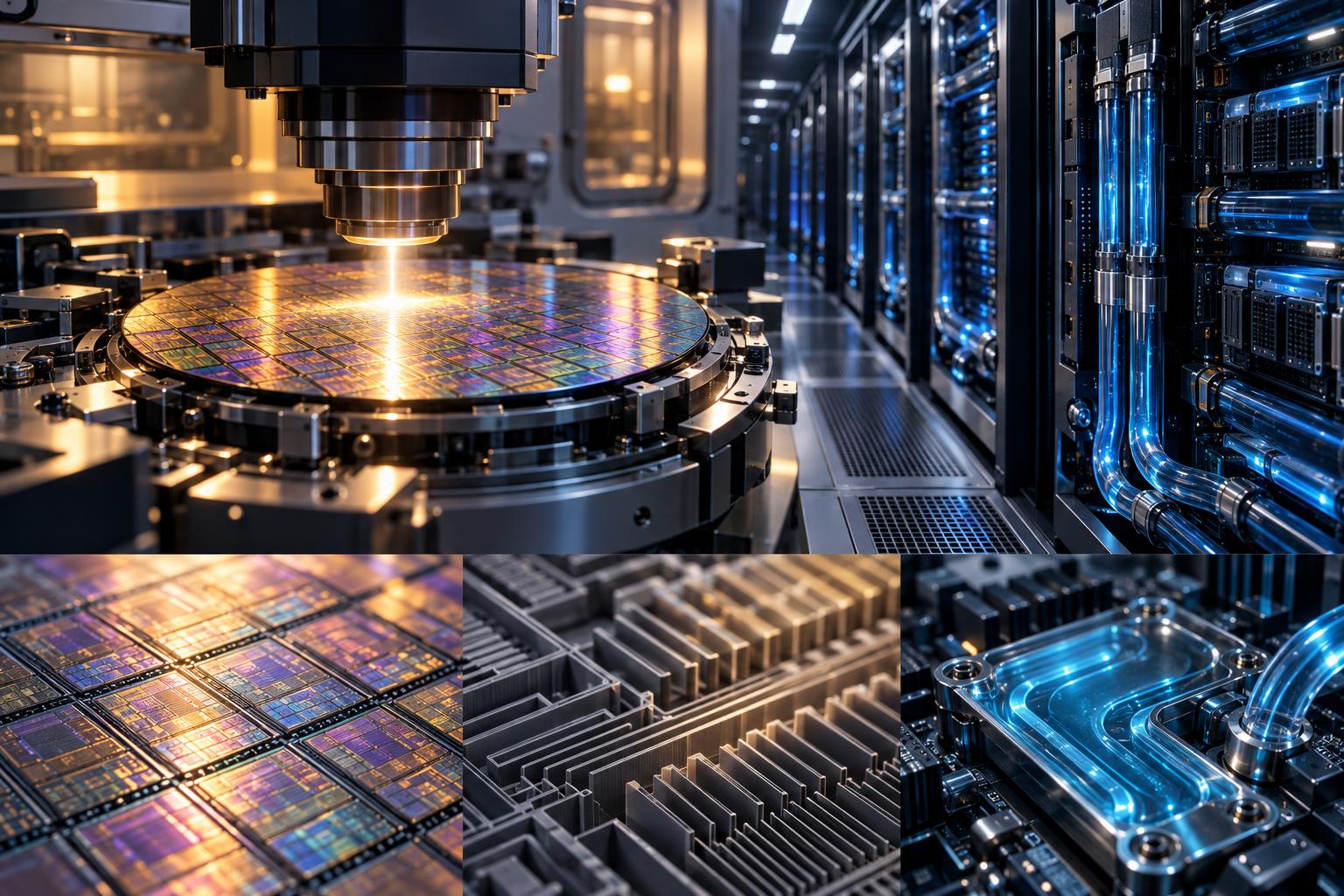
These architectures leverage cutting-edge fabrication technologies to pack more transistors onto a single chip, enhancing processing power while minimizing energy usage. The use of advanced interconnects and memory hierarchies also plays a crucial role in minimizing data transfer bottlenecks, allowing for more efficient data flow between processing units and memory. This design philosophy is central to achieving the balance between performance and power efficiency that modern AI applications demand.
Performance Trade-offs and Compute Demands
While advanced silicon offers remarkable performance gains, it also presents certain trade-offs. The complexity of these chips can lead to increased production costs and challenges in heat dissipation, necessitating sophisticated cooling solutions. Additionally, the high power density of these chips requires careful management to prevent thermal throttling, which can degrade performance. These factors must be considered when deploying AI systems at scale.
"Balancing performance and efficiency is key in advanced silicon design."
Despite these challenges, the benefits of advanced silicon in terms of computational efficiency and speed far outweigh the drawbacks. These chips enable AI models to run faster and more efficiently, reducing the time and energy required for training and inference. As a result, organizations can achieve greater throughput and lower operational costs, making advanced silicon a vital component of modern AI infrastructure.
3. Real-World Implementation & Comparative Breakdown
Case Study: AI-Powered Healthcare Diagnostics
In the realm of healthcare, advanced silicon is transforming the capabilities of AI-powered diagnostic tools. For instance, a leading medical imaging company has integrated GPUs into its systems, enabling real-time analysis of MRI and CT scans. This integration has resulted in a 50% reduction in diagnostic times, allowing radiologists to make quicker and more accurate assessments. The GPUs' ability to handle complex image processing tasks with high precision has led to improved detection rates of early-stage diseases.
Furthermore, the use of NPUs in portable diagnostic devices has expanded access to healthcare in remote regions. These devices, powered by efficient AI chips, can perform complex analyses on-site, reducing the need for centralized laboratory testing. This has not only improved patient outcomes but also reduced healthcare costs by minimizing the need for expensive infrastructure and personnel.
Comparative Technical Dimensions
| Technical Dimension | Legacy / Standard Approach | Modern Frontier Approach |
|---|---|---|
| Processing Power | Limited to CPU capabilities | Enhanced with GPUs/NPUs |
| Energy Efficiency | High power consumption | Optimized for low power use |
| Latency | Higher latency in data processing | Reduced latency with parallel processing |
| Scalability | Restricted by hardware limits | Scalable with modular architectures |
| Deployment Flexibility | Cloud-dependent | Edge-compatible |
The comparison table illustrates the stark differences between legacy and modern silicon approaches. Advanced silicon architectures provide a clear advantage in terms of processing power and energy efficiency, making them ideal for high-demand AI applications. Their ability to reduce latency and offer deployment flexibility further enhances their value, particularly in edge computing scenarios.
4. Operational Bottlenecks, Edge Cases & Guardrails
Challenges in Scaling and Security
Despite the benefits, deploying advanced silicon in AI systems is not without challenges. Scaling these systems across large data centers can lead to significant heat generation, necessitating robust cooling infrastructures. Additionally, the complexity of these chips can introduce security vulnerabilities, as the intricate design may harbor undiscovered flaws. Ensuring the integrity and security of AI models running on these chips is paramount, requiring rigorous testing and validation processes.
Deployment Prerequisites
To successfully implement advanced silicon solutions, organizations must consider several key prerequisites:
- Robust cooling solutions are essential to manage the heat generated by high-performance chips. Effective thermal management ensures sustained performance and reliability.
- Security protocols must be established to protect against potential vulnerabilities in chip design. Regular audits and updates can help mitigate risks.
- Infrastructure readiness is crucial, with data centers needing to accommodate the power and space requirements of advanced silicon architectures.
- Training and expertise in advanced silicon technology are necessary to maximize the potential of these systems. Investing in workforce development can enhance deployment outcomes.
- Scalability planning is required to ensure that AI systems can grow alongside increasing computational demands. This includes modular design approaches and future-proofing strategies.
5. Future Trajectory & Strategic Blueprint
Evolution Over the Next 12–24 Months
Looking ahead, the evolution of advanced silicon is poised to accelerate, driven by ongoing research and development. Over the next 12 to 24 months, we can expect to see further miniaturization of chip architectures, allowing for even greater power efficiency and performance. Innovations in materials science, such as the use of new semiconductors, are likely to play a pivotal role in this advancement. These developments will continue to push the boundaries of what is possible with AI, enabling more complex models and applications.
Moreover, the integration of AI-specific silicon into a broader range of devices will become increasingly common. From smartphones to IoT devices, the ability to perform AI computations locally will enhance user experiences and unlock new functionalities. This trend will further blur the lines between cloud and edge computing, as the capabilities of edge devices grow to rival those of centralized data centers.
Strategic Roadmap for Adoption
For organizations looking to adopt advanced silicon, a strategic roadmap is essential. The first step is to assess current infrastructure and identify areas where advanced silicon can provide the most significant impact. This assessment should consider both immediate needs and long-term goals, ensuring that investments align with broader organizational objectives.
Next, organizations should focus on building partnerships with leading silicon manufacturers and technology providers to stay at the forefront of innovation. Collaboration with these stakeholders can facilitate access to cutting-edge technologies and expertise. Finally, ongoing investment in research and development will be crucial to maintain a competitive edge, as the landscape of AI silicon continues to evolve rapidly. By taking a proactive approach, organizations can position themselves as leaders in the next generation of AI computing.