
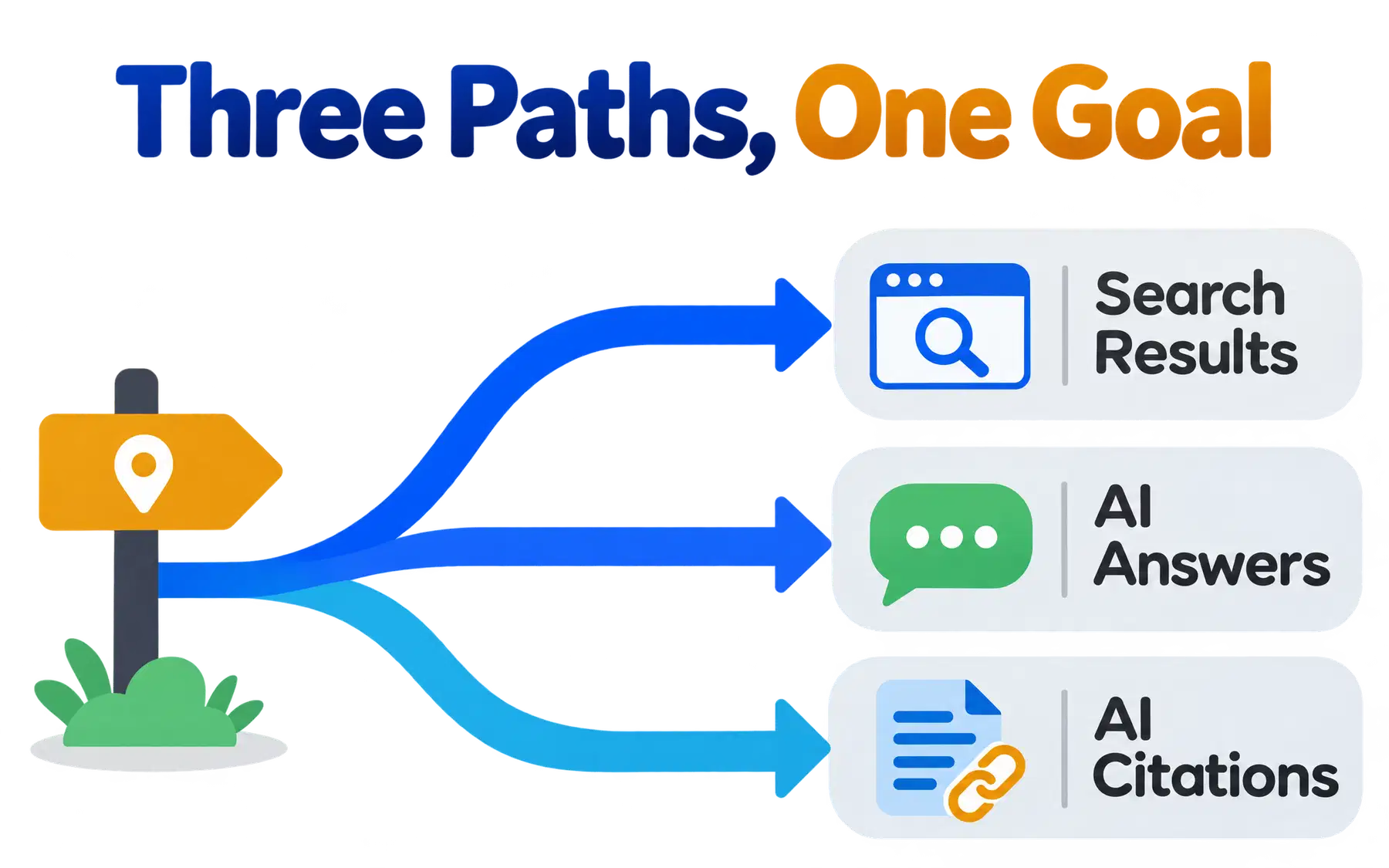
The short version of the seo vs geo vs aeo difference: SEO gets your page to rank in a list of search results, GEO gets your brand cited inside AI-generated answers, and AEO gets your content served as the direct answer to a specific question. Most businesses do not need all three at full intensity right now, and the useful question is not "what do these acronyms mean" but "which one deserves next quarter's hours and money."
This article covers the definitions and a comparison table, a scoring framework tied to your business type, sales cycle, and current traffic mix, and the measurement stack that tells you whether any of it is working.
In this article
- What SEO, GEO, and AEO Actually Mean (Fast Definitions)
- SEO vs GEO vs AEO Difference: Side-by-Side Comparison Table
- How They Overlap in Practice
- Which One Should You Prioritize First? A Decision Framework by Business Type
- How to Measure Each One: Metrics and Tools That Actually Exist Today
- Common Mistakes When Choosing Between SEO, GEO, and AEO
- What Changes for Your Content: Practical Adjustments Across All Three
- Where AI Search Visibility Tools Fit In
- Frequently asked questions
Do ChatGPT, Claude, Perplexity & Gemini recommend your website?
Own the search – on Google and across AI
AI-powered SEO that wins in Google and AI search
What SEO, GEO, and AEO Actually Mean (Fast Definitions)
SEO (search engine optimization) is the practice of making a page easy for a search engine to crawl, understand, and rank against competing pages for a query. It covers keywords, site speed, internal links, backlinks, and content quality. The payoff is a position in a list of blue links, and the click that follows. Analogy: SEO is getting your shop onto the busiest street in town.
GEO (generative engine optimization) is the practice of making your content the kind of source a large language model reaches for when it writes an answer. The target is not a ranking position but a citation, a brand mention, or an inclusion in the synthesized response inside ChatGPT, Perplexity, Gemini, Claude, or Google's AI Overviews. Analogy: GEO is becoming the expert that journalists quote, rather than the one who publishes a press release.
AEO (answer engine optimization) is the practice of structuring content so a machine can lift one clean, correct answer out of it. That means question-shaped headings, a direct answer in the first two sentences, schema markup, and tight formatting. The payoff is a featured snippet, a People Also Ask slot, a voice assistant response, or the top line of an AI answer. Analogy: AEO is writing the dictionary entry, not the essay.
AEO and GEO are routinely treated as the same thing, but they are not. AEO is about being extracted as a concise answer to a known question, a formatting problem. GEO is about being chosen as a trusted source during generation, an authority and entity-recognition problem. You can be perfectly structured and never cited, and cited constantly while never owning a snippet.
One-line test: if the win is a box on a results page, that is AEO. If the win is your brand name appearing inside a paragraph an AI wrote, that is GEO. If the win is a click from position three, that is SEO.
SEO vs GEO vs AEO Difference: Side-by-Side Comparison Table
The table below is the fastest way to see the seo vs geo vs aeo difference across every dimension that affects a budget decision, including the one most comparisons leave out: how long each discipline takes to show a result.
| Dimension | SEO | GEO | AEO |
|---|---|---|---|
| Primary goal | Rank in organic search results and earn the click | Get cited and mentioned inside AI-generated answers | Be served as the direct answer to a specific question |
| Target platform | Google, Bing, YouTube search, app stores | ChatGPT, Perplexity, Gemini, Claude, Google AI Overviews and AI Mode | Featured snippets, People Also Ask, knowledge panels, voice assistants |
| Unit of success | A ranking position | A citation or brand mention | An extracted answer block |
| Content style | Comprehensive pages built around search intent and topic coverage | Context-rich content with original data, named experts, and quotable claims | Concise, literal answers under question-shaped headings |
| Core tactics | Keyword research, technical health, internal linking, backlinks, topical clusters | Original research, entity clarity, third-party mentions, citations of credible sources, consistent brand naming | Answer-first paragraphs, FAQ and HowTo schema, tables, definition sentences, plain language |
| Authority signals | Backlinks and domain-level trust | Being referenced elsewhere, original data, expert attribution | Accuracy, source attribution, clean markup |
| Main success metric | Rankings, organic sessions, conversions from organic | Citation frequency, share of voice across AI platforms, AI referral sessions | Snippet and PAA ownership rate, impressions without clicks, assistant answer accuracy |
| Typical time to first result | 3 to 9 months for competitive terms | 4 to 12 weeks for citation movement once authority exists, longer from a standing start | 2 to 8 weeks on pages that already rank |
| Who it suits best | Ecommerce, high-volume transactional and commercial queries | SaaS, B2B, consultancies, publishers with research to share | Local service businesses, support content, short-answer categories |
| Biggest risk | Zero-click erosion of traffic from high-ranking pages | Measurement blind spots and unstable platform behavior | Winning the answer and losing the visit |
How They Overlap in Practice
A well-built page does all three jobs at once. The overlap is not a coincidence, it is the whole reason a single content budget can serve three outcomes. A page with a clear H2 structure and a direct answer under each heading is easier for Google to extract as a snippet (AEO) and easier for a crawler to parse into clean passages (SEO). Original data and named expert quotes build the experience and expertise signals Google rewards (SEO) while giving a language model something specific worth citing (GEO).
The strongest evidence for the overlap is in the citation data. Ahrefs analyzed 863,000 keyword SERPs and 4 million AI Overview URLs and found that 38% of pages cited in AI Overviews also rank in the top 10, while a separate analysis using different methodology reported about 17% top-10 overlap. Either way, organic ranking and AI citation are linked, not independent.
That overlap also explains why abandoning SEO to "go all in on GEO" is self-defeating: the crawling, indexing, and authority work that makes a page rank is the same work that makes it eligible for a generated answer. Jasper's guide makes the point plainly: GEO and AEO don't replace SEO, they sit on top of it. Because AEO and GEO share surface tactics, they are often mistaken for one discipline. That leads to a specific mistake: a business adds FAQ schema to forty pages, sees no movement in AI citations, and concludes AI search is hype. Schema helps an answer engine extract; it does not make a generative engine trust you. Trust comes from being an originating source of information, not a markup exercise.
- Clear heading structure serves SEO passage ranking and AEO extraction equally.
- Original research and proprietary data serve GEO citation worth and SEO topical authority equally.
- Explicit entity naming (saying "ZentrASI" rather than "we") serves GEO brand recognition and SEO knowledge-graph clarity.
- Factual accuracy with sources serves AEO answer reliability and GEO source selection.
- Site speed and crawlability serve all three, because nothing can cite a page it cannot fetch.
Which One Should You Prioritize First? A Decision Framework by Business Type
If you can only do one well this year, the answer depends on three things: what kind of business you run, how long your sales cycle is, and how mature your existing content already is. Here is a scoring approach you can run in about ten minutes.
Step 1: Score yourself on four factors
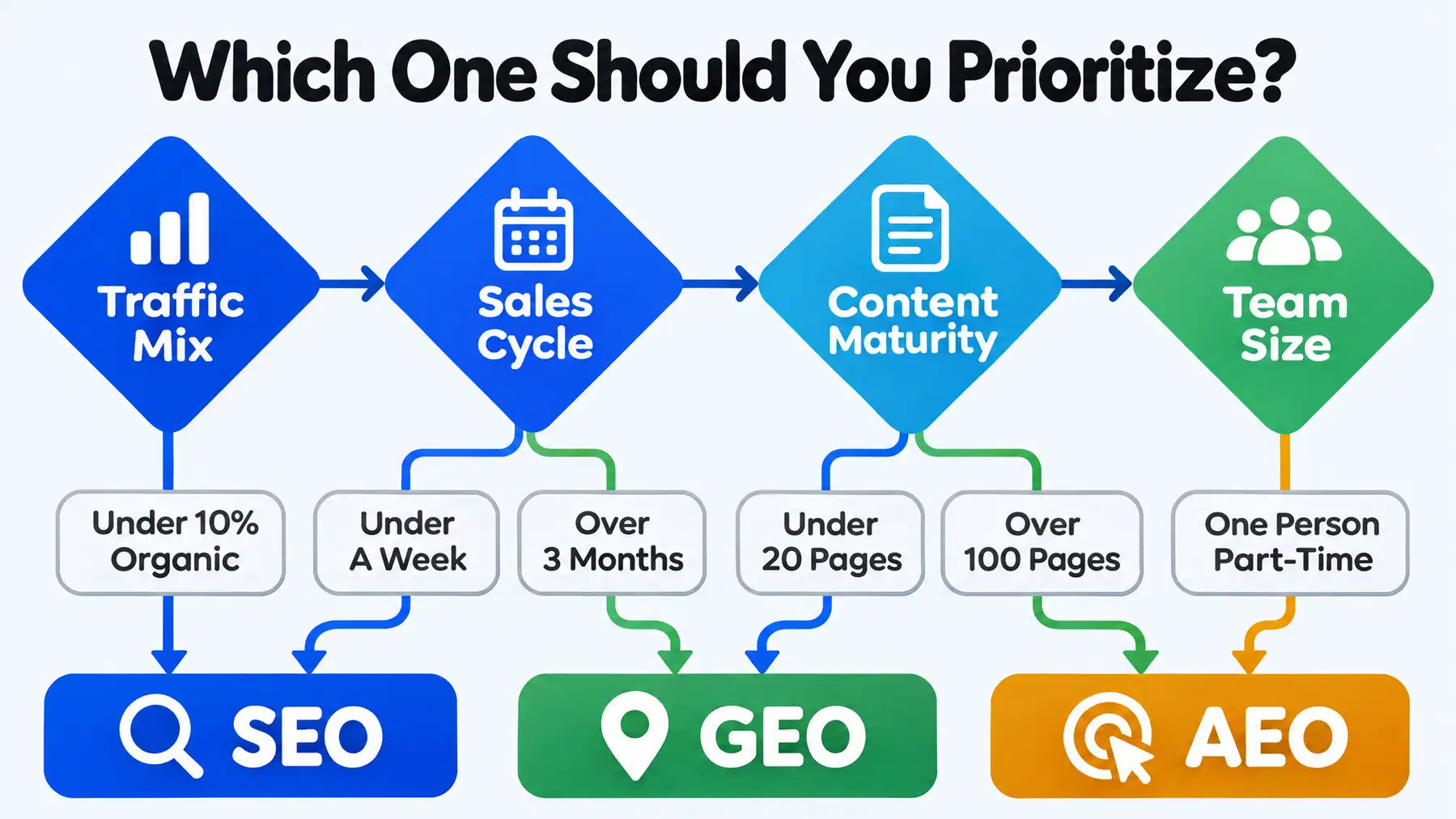
- Traffic mix today. If organic search already drives 30% or more of your leads, you have an SEO foundation to build on. Under 10% means a visibility problem, not a GEO problem.
- Sales cycle length. Under a week (a plumber, a dentist, a takeaway) points to AEO. Over three months with multiple stakeholders points to GEO, since buyers use AI assistants to shortlist vendors before visiting a site.
- Content maturity. Fewer than 20 substantive pages means your first job is publishing, not optimizing. More than 100 pages with real depth means you have raw material a generative engine can draw from.
- Team size. One person part-time can run AEO well, since it is largely a formatting discipline. GEO needs someone who can produce original data and secure mentions.
Step 2: Match your profile to a priority
| Business type | Typical sales cycle | Prioritize first | Why | What to layer second |
|---|---|---|---|---|
| Local service business (trades, clinics, legal, restaurants) | Hours to days | AEO | Your customers ask short, literal, high-intent questions. Winning the answer box, the map pack answer, and the assistant response captures the decision at the moment it is made. | Local SEO fundamentals, then light GEO via review sites and local press |
| SaaS and B2B services | 1 to 9 months | GEO | Buyers research with AI assistants across a long cycle. Being cited as a credible source during the shortlist stage is worth more than one extra ranking position. | AEO on comparison, pricing, and integration pages |
| Ecommerce and high-transaction retail | Minutes to weeks | SEO | Transactional and shopping queries still send clicks, and product discovery depends on indexed, structured product data. | AEO on product specs, sizing, returns, and buying-guide content |
| Publishers and media | Not applicable, monetized by attention | SEO plus GEO together | Volume depends on rankings, but survival depends on being the cited source rather than the scraped one. | AEO on evergreen explainers that get summarized away |
| Early-stage business with thin content | Any | SEO | There is nothing for an AI to cite yet. Publish and get indexed first. | AEO once 20 to 30 solid pages exist |
Step 3: The honest trade-off
If your score says AEO, the good news is it is the cheapest of the three to start: rewriting your top 20 pages so each H2 is followed by a 40-word direct answer, plus correct schema, can be done in a few weeks by one person. If it says GEO, budget for original research, since that is what language models reward and what competitors cannot copy. If it says SEO, accept that click rate on informational content will keep falling and shift budget toward commercial intent pages.
Rule of thumb for a constrained quarter: fix the foundation (technical SEO and indexing), then pick the single discipline your business type points to, and give it 70% of the content budget. Split the remaining 30% across the other two. Do not try to run three programs with one person.
How to Measure Each One: Metrics and Tools That Actually Exist Today
This is the section competing articles skip, and it is the one that decides whether your investment survives the next budget review. Each discipline has a different measurement stack, and only one of them is mature.
Measuring SEO
This is solved ground. Rank tracking against a defined keyword set, organic sessions and conversions in your analytics platform, and impressions, clicks, and average position in Google Search Console. The one adjustment worth making now: track impressions without clicks as its own line. Rising impressions with flat clicks is not failure, it is the zero-click economy showing up in your data, and you need to be able to explain it before someone else misreads it.
Measuring AEO
Track featured snippet and People Also Ask ownership for your target questions. Most major rank trackers now flag SERP features, so you can see which queries trigger an answer box and whether you own it. Validate your structured data with a schema testing tool before you trust any of it, because broken markup fails silently. Watch Search Console for queries where you hold a high average position and an unusually low click-through rate: those are pages where you are probably supplying the answer and not getting the visit.
Measuring GEO
Citation tracking means running a set of representative prompts across the major AI platforms on a schedule and recording whether your brand appears, how often, and against which competitors. That gives you a share of voice figure per platform. Doing this by hand for twenty prompts across four platforms once a month is realistic; doing it for two hundred is not, which is why dedicated tooling exists.
Referral tracking costs nothing to set up. Traffic from AI assistants shows up in analytics as plain referral traffic with no UTM parameters, under hostnames like chatgpt.com, perplexity.ai, and gemini.google.com. Create a custom channel group so these are reported separately instead of being dumped into "referral" or "direct". Judge the volume on conversion rate and assisted conversions, not sessions, since these visitors usually arrive late in the decision process.
Server log analysis is the third piece, and the one that gets ignored. Your logs show which AI crawler user agents are fetching your pages, how often, and which sections they ignore. If the crawlers are not fetching a page, that page cannot be cited, and no amount of content work will change that until the access problem is fixed.
Why SEO and GEO metrics move together
Do not report these in isolation. Since a substantial share of AI Overview citations come from pages already ranking in the top results, improvements in organic position often show up as citation gains a few weeks later. Pew Research found that around one-in-five Google searches produced an AI summary in its study period, and Comscore measured AI Overviews on 39.4% of U.S. desktop queries in June 2026, so the overlap between the two systems is now too large to treat as separate reporting lines.
Common Mistakes When Choosing Between SEO, GEO, and AEO
Most of the damage comes from a handful of repeated errors:
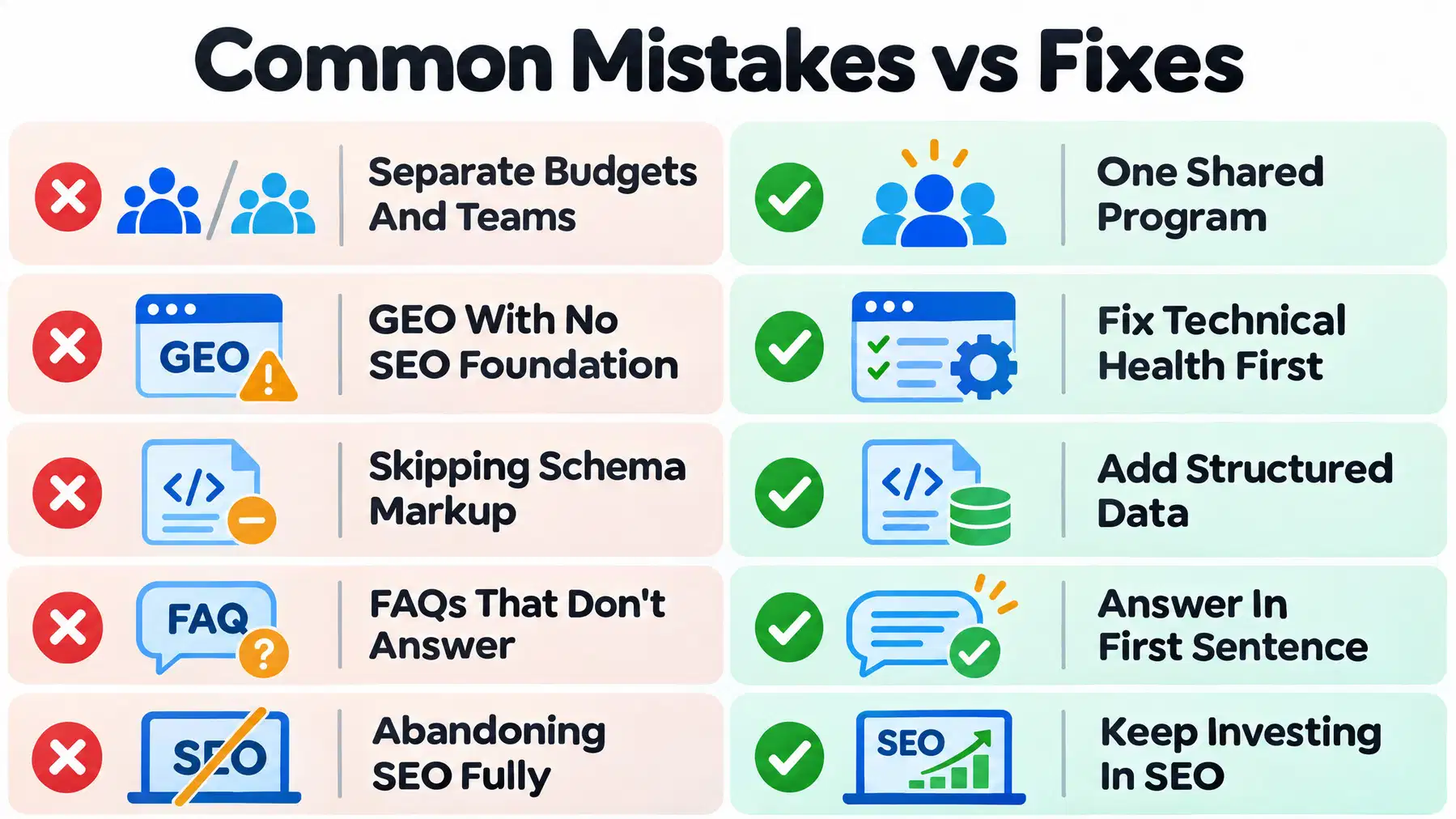
- Treating them as three separate budgets and teams. They share the same content, crawl infrastructure, and signals. Splitting them into silos triples overhead and produces three incomplete programs.
- Chasing GEO with no SEO foundation. If pages are slow, thin, or not indexed, there is nothing to cite. Technical health is a prerequisite, not an alternative.
- Skipping schema markup. Structured data is how machines resolve what your page is about without guessing. It is cheap and still the highest-leverage AEO work available.
- Writing FAQ sections that do not answer the question. A heading followed by three paragraphs of context is not an answer; the answer needs to come in the first sentence.
- Abandoning SEO because of zero-click fear. Zero-click searches now account for 68% of U.S. Google searches, up from 49% in 2019, and one Forbes analysis puts the figure near 60% of searches ending without a click. That is a reason to change what you optimize for, not a reason to stop.
What Changes for Your Content: Practical Adjustments Across All Three
You do not need three content programs. You need one program with some specific production rules. These are the changes that pay across SEO, GEO, and AEO at the same time.
- Answer first, elaborate second. Under every H2, the first two sentences should directly answer the question in that heading, then add nuance.
- Publish something only you have. A survey of your customers, anonymized platform data, a benchmark from your own operations, a named expert quote. Generative engines cite sources with information not available elsewhere.
- Name your entities explicitly. Write "ZentrASI recommends" rather than "we recommend". Models and knowledge graphs connect brands to topics through explicit naming.
- Add the right schema types. Organization and Person for identity, Article or BlogPosting for content, FAQPage for genuine Q&A, Product and Offer for ecommerce, LocalBusiness for physical locations, HowTo for procedures. Validate every one.
- Use tables, definition sentences, and lists deliberately. A comparison table is extractable in a way prose is not.
- Update on a detectable cadence. Review important pages quarterly and change something substantive. Stale pages drift out of the citation pool.
None of this requires a new team. It requires an editorial checklist applied to every page before it ships, and a quarterly pass over the pages that already earn you something.

Grow organic traffic from Google and AI search
Get recommended by Google and ChatGPT without needing an SEO team. We match your brand voice, highlight your products you sell, and create articles that rank and get cited without sounding like generic AI content
Where AI Search Visibility Tools Fit In
The measurement gap described earlier is the real constraint on GEO and AEO work. You can see rankings in Search Console and organic traffic in analytics, but nothing in the standard stack tells you how often ChatGPT, Perplexity, Gemini, or Claude mention your brand, or whether a competitor is cited more often for the questions that matter to your pipeline. Without that, you are optimizing on faith.
A dedicated AI search visibility tool closes that gap by running your prompt set across platforms on a schedule and reporting citation frequency, share of voice, sentiment, and competitor comparison over time. Combined with the referral channel and server log work above, it gives you the same kind of trend line you already expect from rank tracking, which is what makes a GEO budget defensible internally.
ZentrASI covers this category in its guide to AI search visibility tools, which compares solutions that track brand presence across Google and AI platforms including ChatGPT, Claude, Perplexity, and Gemini, and that identify content opportunities across places like Reddit and Q&A sites. If you want the broader picture of how practical AI fits into the rest of your operations, the ZentrASI library on applied AI for business is a good starting point.
One caution: this tooling category is young and changing fast. Treat the numbers as directional, not precision measurement, and keep your own prompt set stable so comparisons stay honest. A simple approach to tracking AI search visibility across platforms consistently beats a sophisticated one you abandon after two months.
Frequently asked questions
What is the difference between SEO, GEO, and AEO?
SEO optimizes pages to rank in traditional search results and earn clicks, GEO optimizes content to be cited inside AI-generated answers, and AEO optimizes content to be extracted as the direct answer to a question. They share infrastructure but reward different work.
Is AEO the same as GEO?
No. AEO is a formatting discipline aimed at getting one clean answer extracted, while GEO is an authority discipline aimed at being chosen as a trusted source during AI generation. You can win snippets without being cited by an AI assistant, and vice versa.
Does GEO replace traditional SEO?
No. Ahrefs found that 38% of pages cited in AI Overviews also rank in the top 10 organic results, meaning ranking and citation performance are linked. GEO sits on top of a working SEO foundation.
Can small businesses compete in GEO and AEO?
Yes, often more easily than in competitive SEO, because citation selection rewards specificity and original information over domain size.
How long does it take to see results from GEO optimization?
With existing authority and indexed content, citation movement typically becomes visible within four to twelve weeks. From a standing start with thin content, expect six months or more.
What is AIO and how does it relate to SEO, GEO, and AEO?
AIO is shorthand for AI Overviews, or an umbrella term for AI optimization covering GEO and AEO together. It is not a separate fourth discipline.
Do I need separate content for SEO, GEO, and AEO?
No. One well-structured page with an answer-first opening, original data, explicit entity naming, and valid schema serves all three goals at once.
How do I know if AI platforms are citing my website?
Create a custom analytics channel for referral traffic from hostnames like chatgpt.com, perplexity.ai, and gemini.google.com, and check server logs for AI crawler user agents.
The ZentrASI team
Written by the people behind ZentrASI. ZentrASI is a digital publication and community dedicated to unlocking human potential through machine intelligence and Artificial Super Intelligence.
