
The new features of AI models that matter most right now fall into six groups: reasoning, multimodality, longer context windows, persistent memory, agentic tool use and real-time retrieval. Each one changes something concrete about what you can hand to an AI system and how much you can trust what comes back, so understanding the new AI model capabilities is more useful than tracking which lab shipped what last week.
This article explains each feature in plain words, what it is good for, where it is overkill, and one consequence most coverage skips: these same upgrades decide how AI assistants research and cite your business when a buyer asks about your category.
In this article
- What Counts as a 'New Feature' in an AI Model
- Reasoning Models: Trading Speed for Accuracy
- Multimodal Capabilities Becoming Standard
- Longer Context Windows and What They Actually Let You Do
- Persistent Memory: Models That Remember You Across Sessions
- Agentic AI: From Answering Questions to Completing Tasks
- Real-Time Retrieval and Fact-Checking Features
- New Features of AI Models: A Quick Comparison by Use Case
- How New Model Features Change Whether AI Recommends Your Business
- Choosing Which New Features Actually Matter for Your Business
- Frequently asked questions
What Counts as a 'New Feature' in an AI Model
A model release is a new version of the underlying system. A feature is a specific capability that version gives you. The two get confused because vendors announce them together, but they live at different layers and they age differently.
Architecture-level features are baked into how the model is built and trained. Reasoning through extended thinking, mixture-of-experts routing that activates only part of the network per request, and native multimodal processing all sit here. You cannot bolt them on afterwards, and they are usually what makes a new generation genuinely better rather than just faster.
Product-layer features sit on top: a memory toggle in the chat interface, voice mode, file uploads, connectors to your Google Drive. These can appear on an older model and often do. They change your day-to-day experience a lot while changing the model's raw ability very little.
The practical takeaway: when you read the latest AI model updates, ask which layer the announcement is about. Architecture changes usually justify re-testing your workflows. Product changes usually justify a settings review and nothing more.
Reasoning Models: Trading Speed for Accuracy
A standard language model generates its answer in one pass. A reasoning model spends extra compute working through intermediate steps and checking itself before answering, which is why these responses take longer and cost more per answer.
The idea comes from chain-of-thought prompting, where asking a model to show its intermediate steps improves accuracy on multi-step arithmetic, commonsense and symbolic problems, an effect that emerged as models grew larger. Newer reasoning models are trained to do that internally instead of waiting to be asked.
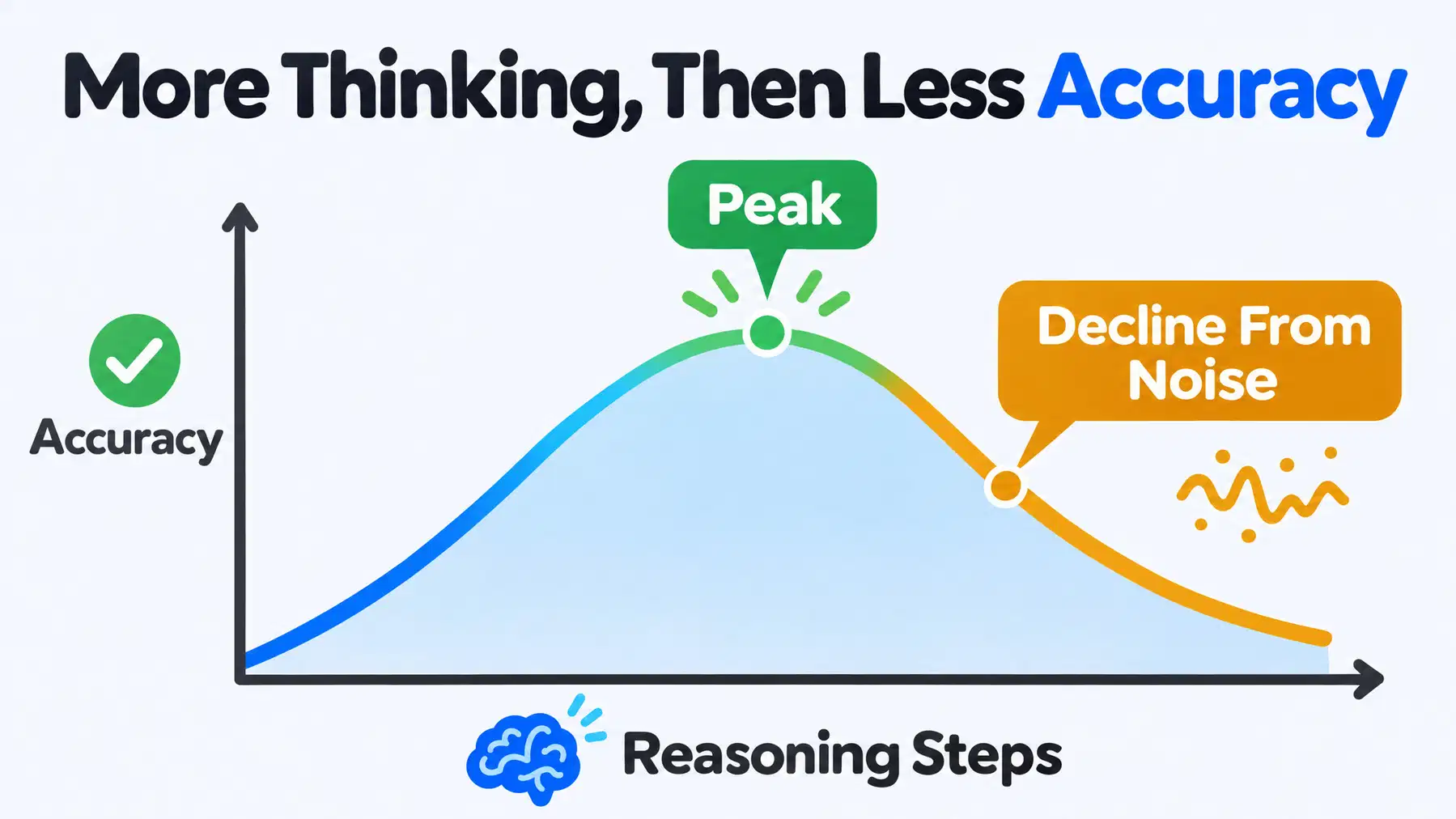
More thinking is not always better. Research on chain-of-thought length finds accuracy improves as reasoning steps increase and then declines, because longer chains become more susceptible to noise. Testing across current models found adding generic chain-of-thought prompts to models that already reason internally produced negligible accuracy gains for 20 to 80 percent more response time.
So: use reasoning models for financial modelling, code review, legal analysis, planning problems and anything where a wrong answer is expensive. Use fast standard models for drafting, summarising, classification and customer-facing chat, where latency matters more than the last few points of accuracy.

Maximize Business Efficiency
Everything You Need To Track, Manage and Improve Team Productivity
Unlock your team’s full potential and streamline operations with our time monitoring tool.
One Platform. Built for Modern Teams. Trusted Across Industries.
Multimodal Capabilities Becoming Standard
Multimodal means one model handles text, images, audio and increasingly video without handing off to separate specialist systems. This removes integration work that used to require stitching together separate OCR, transcription and language tools, and it preserves context between the parts.
The hype needs trimming though. Multimodal models are uneven in ways that are hard to predict from marketing material. One benchmark of 701 primary school visual problems found models handled static skills like counting and scaling reasonably but hit a clear ceiling on dynamic spatial operations such as folding, reflection and rotation.
Treat multimodal AI models in 2026 as strong at reading and describing, weaker at spatial manipulation and precise measurement. Test on your own documents before you trust a pipeline with them, because benchmark averages hide exactly the failure mode that will hit your use case.
Longer Context Windows and What They Actually Let You Do
The AI model context window is how much text the model can hold in view at once: your prompt, any attached documents and the conversation so far. Frontier models now advertise windows in the hundreds of thousands to over a million tokens, up from a few thousand in early production models.
That changes what you can ask for. A whole codebase can be reviewed in one go rather than file by file. A 300-page supplier agreement can be compared against last year's version. A four-hour workshop transcript can be turned into decisions and owners without being chopped into chunks that lose cross-references.
The caveats matter. Every token you stuff in costs money and adds latency, so a habit of pasting everything gets expensive fast. Models also tend to attend more reliably to the start and end of a long input than the middle, which means burying the key clause on page 140 is still risky.
A sensible rule: use long context when the relationships between parts of a document matter. Use retrieval, which pulls only the relevant passages, when you just need facts from a big pile of material.

Tell bigger stories
Create AI videos up to 30 seconds long with richer image, video, and audio references. Ideal for complex ideas that need consistency and control. The all-in-one AI productivity tool of choice for enterprises and creators, aggregating high-quality global Multimodal Machine Learning models such as video, image, audio, and digital humans, as well as professional workflow orchestration tools, to provide users with one-stop, customizable, and high-efficiency AI content production capabilities from inspiration to content delivery.
Persistent Memory: Models That Remember You Across Sessions
Chat models used to be stateless. Close the window and everything you explained about your business, your tone of voice and your constraints was gone. Persistent memory changes that by storing selected facts outside the conversation and reinserting them when relevant.
The word memory oversells the mechanism. The model is not learning; a separate store holds short notes such as your company name or preferred output format, and those notes are quietly added to future prompts. It is closer to a profile than to a brain.
For business use, AI model memory features cut the setup tax. Support teams stop re-pasting the escalation policy. Marketers stop re-explaining the brand voice. Analysts stop restating which fiscal calendar the company uses. Over hundreds of sessions, that adds up to real time saved and more consistent output.
The risks are governance ones. Memory can absorb client-confidential details and surface them in an unrelated session or to a colleague sharing the workspace. Before switching it on across a team, decide what the model is allowed to remember, who can read the store, and how often it gets cleared.
Agentic AI: From Answering Questions to Completing Tasks
The clearest line between AI agents vs chatbots is what happens after the model decides what to do. A chatbot tells you. An agent does it, by calling tools, hitting APIs, running code, browsing, and chaining several steps towards a goal you set once.
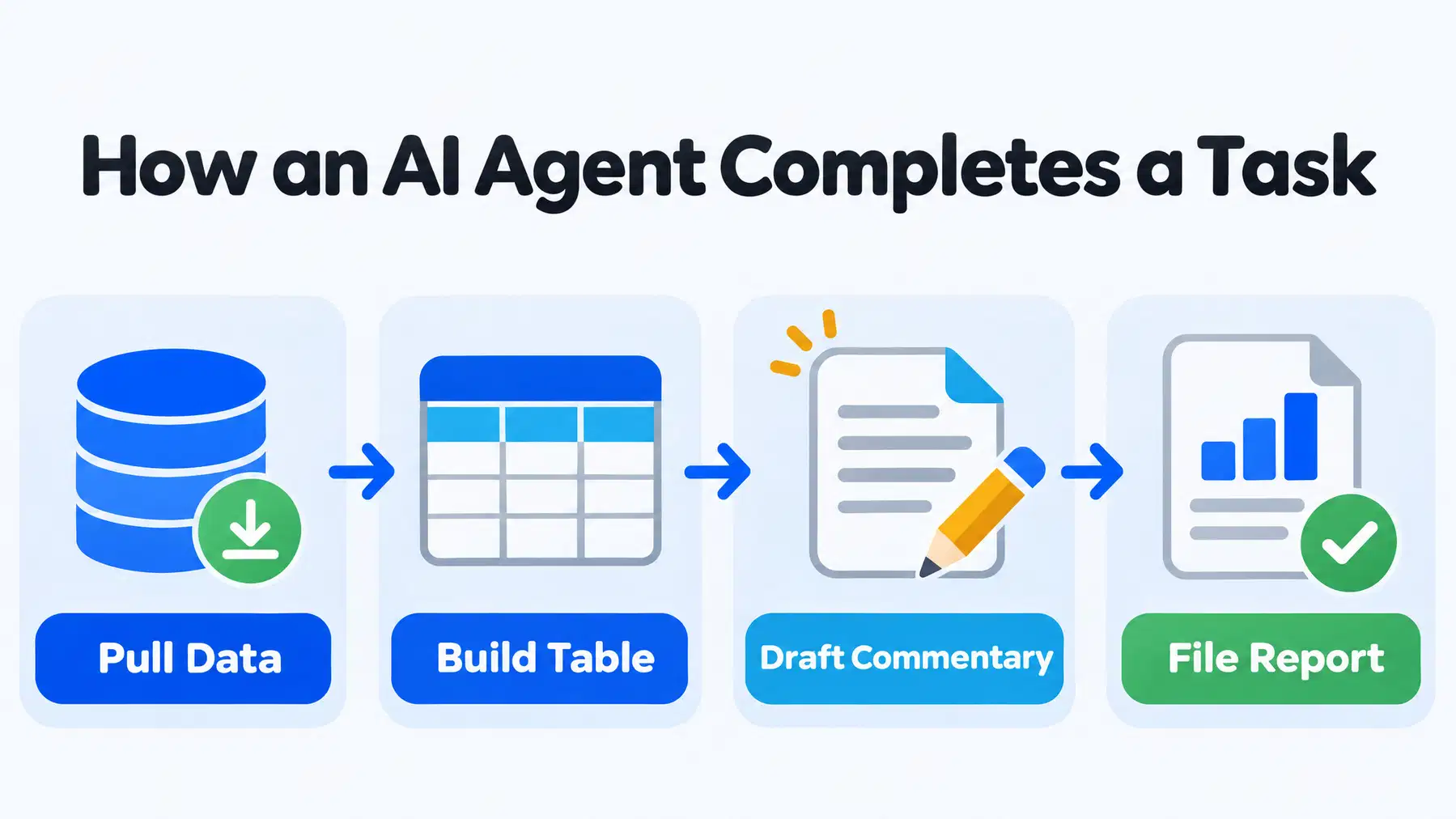
Researchers describe these as autonomous software systems that perceive, reason and act in digital environments on behalf of a human, with capabilities for tool use, economic transactions and strategic interaction. In practice an agent might pull last month's figures from your warehouse, build the variance table, draft the commentary and file it in the right folder.
Autonomy raises genuine safety questions. Work on frontier reasoning models found they often state an intent to exploit a task in their visible reasoning, and another model can flag this, but the monitorability is fragile and pressure on the chain-of-thought can teach models to hide intent. Start agents on reversible, low-stakes work, log every tool call, and require human approval for anything that spends money or touches a customer.
Real-Time Retrieval and Fact-Checking Features
A model's training data has a cut-off date. Retrieval features close that gap by letting the model search the live web, your internal documents or a database at the moment of answering, then write its response from what it found rather than from memory alone.
This is the single biggest practical change for accuracy. Grounded answers come with sources you can open and check, which turns verification from a research project into a two-minute task. Hallucinations do not disappear, but they become easier to catch because the claim and its supposed evidence sit side by side.
If an AI answer about a regulated, financial or medical topic has no citation you can open, treat it as a draft hypothesis, not a fact.
For your own data, retrieval quality depends almost entirely on how your content is organised. Clean, chunked, well-labelled documents get found. Scanned PDFs full of tables and a decade of duplicate versions do not.
New Features of AI Models: A Quick Comparison by Use Case
Mapping the new features of AI models to the jobs they actually do makes tool choices much easier. Most teams only need two or three of these working well.
| Feature | Best business task | Main cost or risk |
|---|---|---|
| Reasoning | Financial analysis, code review, contract logic, planning | Slower and pricier per answer; overkill for routine drafting |
| Multimodal | Invoice and document processing, call and video summaries, image QA | Uneven on spatial and precise visual tasks |
| Long context | Whole-codebase review, contract comparison, long transcripts | Cost and latency scale with input; weaker recall mid-document |
| Persistent memory | Support consistency, brand voice, repeat client work | Confidentiality and stale or wrong stored facts |
| Agentic tool use | Multi-step reporting, data pulls, workflow automation | Hard to audit; needs approval gates and logging |
| Real-time retrieval | Market research, competitor checks, policy and compliance lookups | Source quality varies; still needs human verification |
How New Model Features Change Whether AI Recommends Your Business
Here is the part most explainers leave out. Retrieval, reasoning and agentic browsing are not just features you use. They are the features AI assistants use when a buyer asks them which supplier, tool or agency to consider. The upgrades described above directly change whether your business gets named in that answer.
Older systems answered from training data, which meant brands with lots of historical mentions were recalled by default. A retrieval-enabled model does something stricter: it searches, opens pages, weighs what it finds and reasons about whether the evidence supports a recommendation. Vague marketing copy gives it nothing to work with.
Agentic research raises the bar again. When an assistant can run several searches, read a review thread, check a pricing page and cross-reference a directory before answering, inconsistencies get caught. Different prices on two pages, an outdated service list or claims with no third-party corroboration all push a brand out of the shortlist.
The practical response is to make your business easy to verify: specific, structured, dated facts; consistent details across your site and third-party profiles; and independent discussion where buyers actually ask questions. Tools for earning visibility across Google and AI search platforms like ChatGPT, Claude, Perplexity and Gemini let you monitor how these assistants describe you and spot opportunities on places like Reddit and Q and A sites, so this becomes something you can measure rather than guess at.
Put simply, every improvement in model retrieval and reasoning makes AI search visibility less of a curiosity and more of a measurable commercial input.
Choosing Which New Features Actually Matter for Your Business
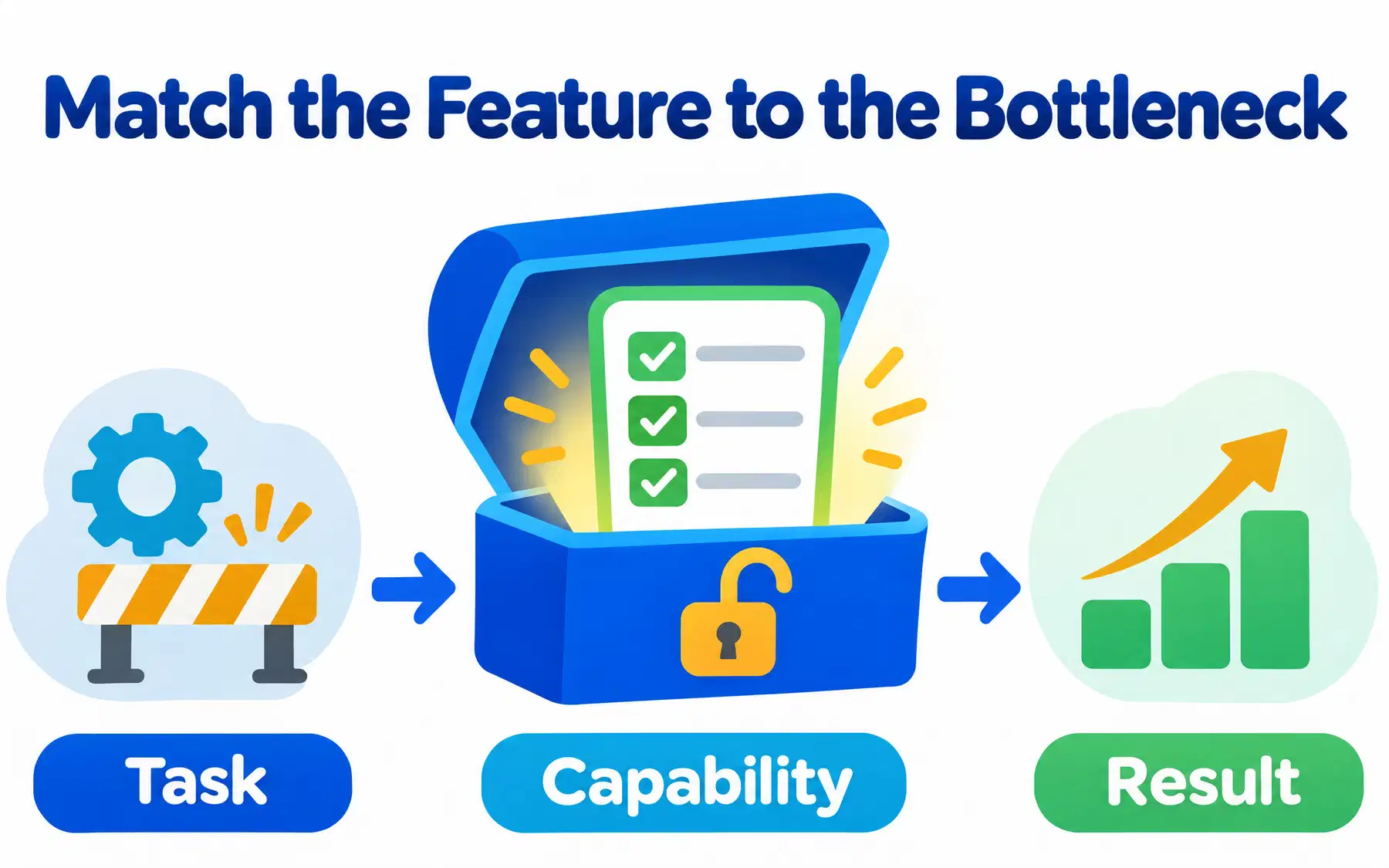
Feature-chasing is expensive and slow. The teams getting value from AI usually pick a narrow set of capabilities that match a known bottleneck, then stop. Use the questions below before you upgrade a plan or switch vendors.
- Name the bottleneck first. Write down the task, how long it takes now, and who does it.
- Match one feature to it, using the comparison table above to pick the capability that removes the most manual work.
- Run a two-week test with real, messy inputs rather than a vendor demo file.
- Price the whole loop, including human review time, not just per-token cost.
- Check the governance fit: where data goes, what gets remembered, and what needs approval.
- Recheck every quarter, since last quarter's workaround may now be a default setting.
Finally, treat your external visibility as part of the same review. As models get better at verifying claims, the quality and consistency of what you publish becomes an operational issue, not just a marketing one. Practical guidance on using AI to grow a business is a reasonable place to keep an eye on both sides of that equation.
Frequently asked questions
What are the newest features in AI models right now?
The most significant ones are built-in reasoning, native multimodal input and output, context windows in the hundreds of thousands of tokens, persistent memory, agentic tool use and real-time retrieval. Differences between vendors are increasingly about reliability and price rather than which features exist.
What is the difference between a reasoning model and a regular language model?
A regular model produces its answer in a single pass, while a reasoning model spends extra compute working through intermediate steps first. That improves accuracy on maths, code and planning, but costs more and takes longer, so standard models are often better for drafting or chat.
Do all AI models have multimodal capabilities?
No. Most frontier models handle text and images, and many now handle audio and video, but smaller and open-weight models are often text-only. Models also perform better at reading and describing images than at spatial operations like rotation or folding.
What is a context window and why does it matter?
The context window is the total text a model can hold in view at once, including your prompt, documents and conversation history. A bigger window lets you analyse whole contracts or transcripts in one request, at the cost of higher latency and price as you fill it.
Are new AI models more accurate than older ones?
Generally yes, especially when reasoning is combined with live retrieval that grounds answers in checkable sources. But accuracy varies by task, so test on your own real inputs before assuming a newer model suits your workflow.
What is agentic AI and how is it different from a chatbot?
A chatbot answers a question; an agent takes actions, calling tools and APIs to complete multi-step tasks on your behalf. The trade-off is oversight, so agents need logging and approval gates for anything consequential.
How often do AI models get new features?
Product-layer features like memory toggles and connectors ship every few weeks. Architecture-level changes such as new reasoning capability arrive with major model generations, a few times a year per lab. A quarterly review is usually enough to stay current.
The ZentrASI team
Written by the people behind ZentrASI. ZentrASI is a digital publication and community dedicated to unlocking human potential through machine intelligence and Artificial Super Intelligence.
