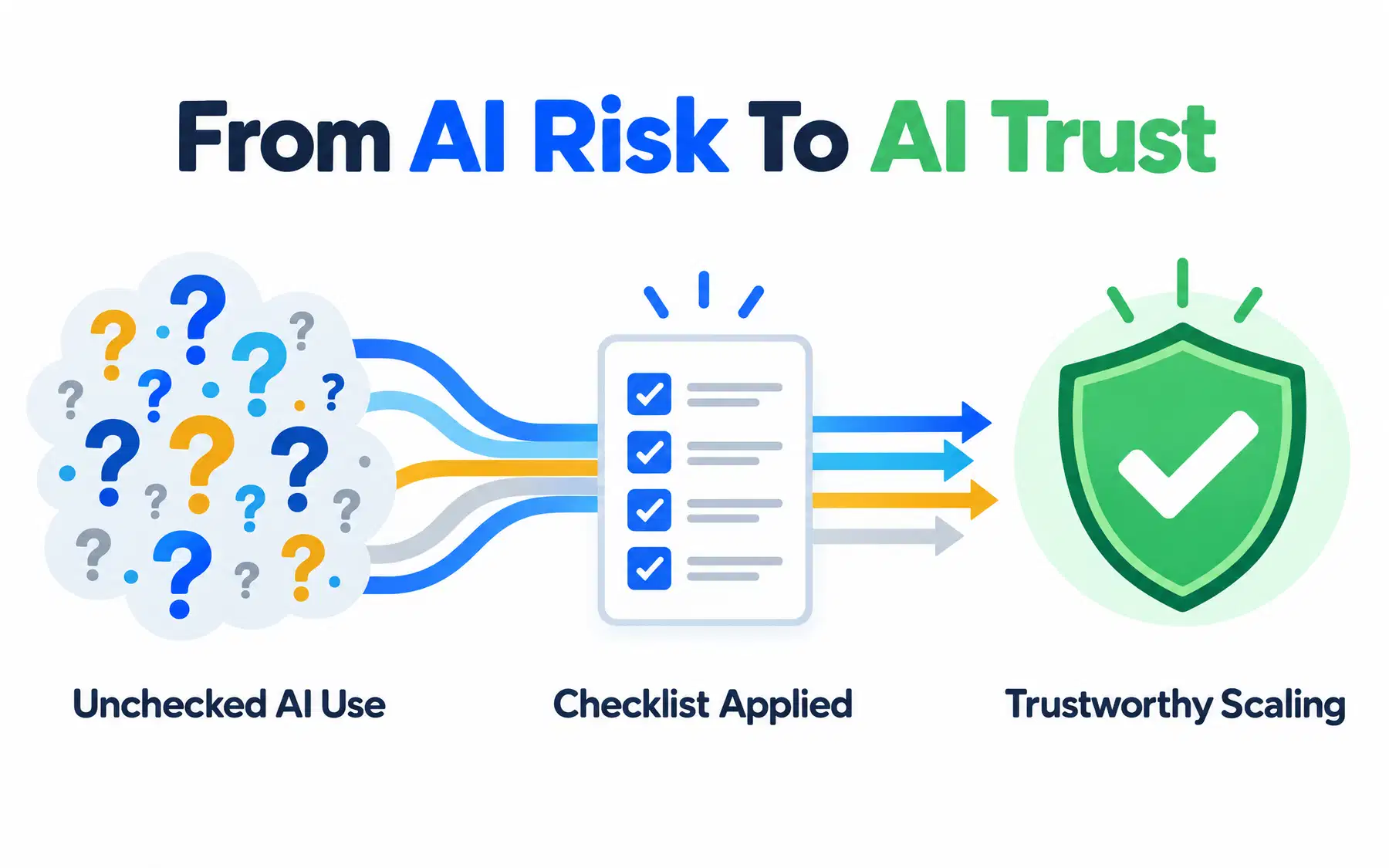
An AI ethics checklist for small businesses is a short, ordered set of yes/no gates you clear before an AI tool moves from one person's experiment to something your whole team, your vendors and your customers touch. This guide gives you nine of those gates, in the order they matter, and each one is designed to be answered by a founder or ops lead in a single working day without legal counsel or a compliance team.
It is not a list of principles. Transparency and fairness are good words, but they do not tell you what to do on the Tuesday morning when three staff are already pasting customer emails into a chatbot. The checklist below is built for that moment.
Blog Post: www.zentrasi.com/ai-ethics-checklist-small-businesses/
In this article
- Why Small Businesses Need an AI Ethics Checklist Before They Scale
- The Scaling Trigger: Why a Checklist That Worked at 1 User Fails at 10
- The AI Ethics Checklist for Small Businesses: 9 Steps Before You Scale
- What the EU AI Act and Other Regulations Actually Require of Small Businesses
- Free Templates and Tools to Run This Checklist Yourself
- When a Step Fails: What to Do Next
- Frequently asked questions
Why Small Businesses Need an AI Ethics Checklist Before They Scale
In most small companies, AI arrives sideways. One person signs up for a free tier, it saves them two hours a week, they tell a colleague, and within a month the tool is in the workflow with nobody having approved it, reviewed the terms, or asked where the data goes.
That path is fast and cheap, which is exactly why it skips review. The costs show up later: customer data sitting in a vendor's training set, a hiring shortlist that quietly filters out disabled applicants, a marketing claim no human checked, or a regulator asking a question you cannot answer. Trust is the slowest thing to rebuild.
European guidance already translates AI principles into a practical self-assessment format for the organisations deploying the tools, not just the ones building them, through the Assessment List for Trustworthy AI. The checklist here is narrower and blunter: it is sequenced for the pre-scaling moment, where the order of the steps is what saves you.
The Scaling Trigger: Why a Checklist That Worked at 1 User Fails at 10
Risk from AI use does not grow in a straight line with headcount. One person using one tool touches one data type and makes zero automated decisions about other people. Ten people using three tools touch customer records, employee records, financials and draft contracts, and some of them are now using AI output to decide things.
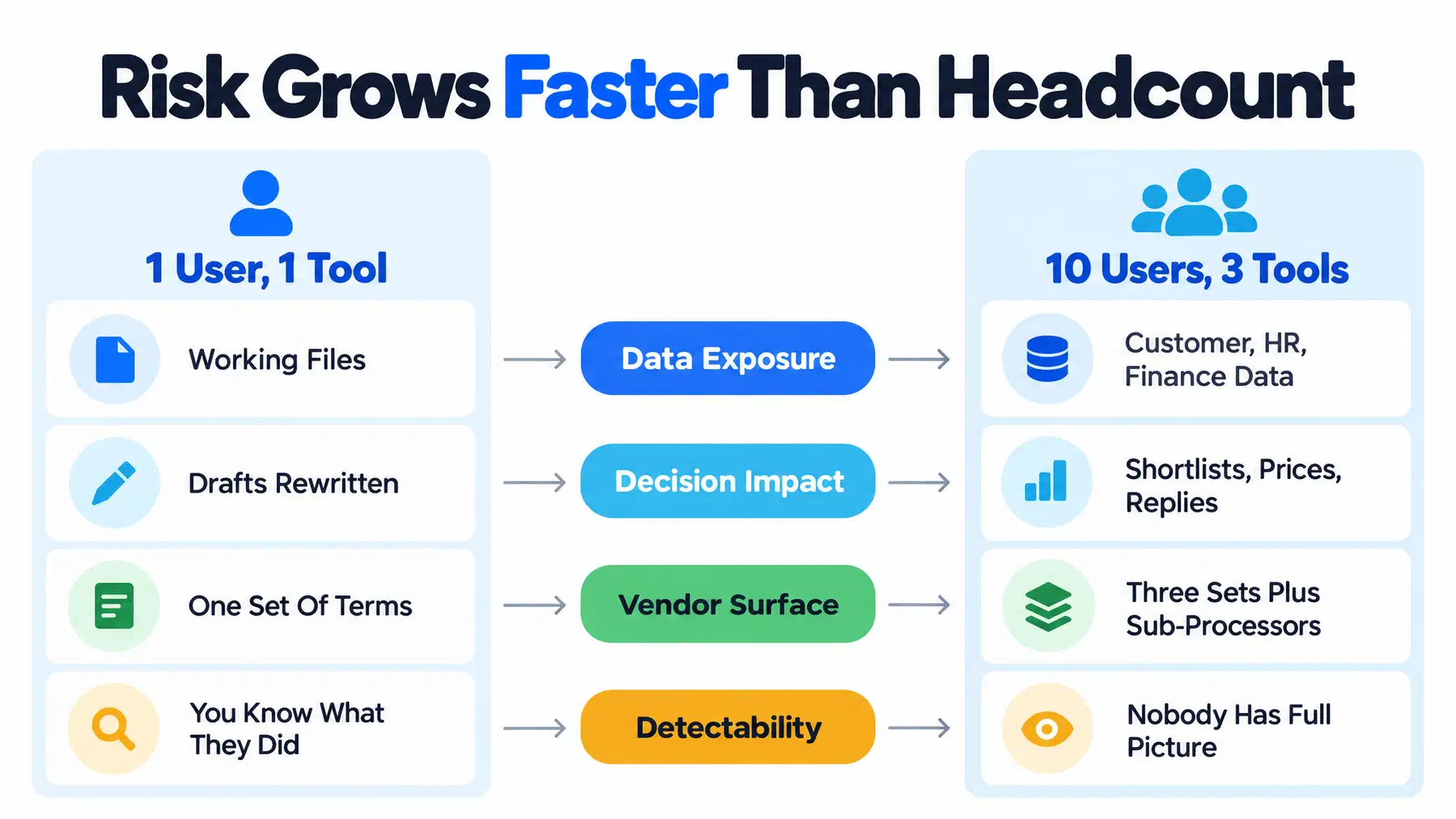
Three things compound at once. More data types enter the system. More people make AI-assisted judgement calls without a shared standard. And each new vendor brings its own sub-processors, so your data footprint widens in places you never signed for.
The re-check rule: treat your checklist as event-driven, not annual. Re-run it whenever one of three triggers fires: a new AI vendor enters the stack, a new category of data goes into an AI tool, or an AI output starts influencing a decision about a customer or an employee.
That rule is the difference between AI governance for small teams and a document that was true once. Most small businesses do not fail because they lacked a policy. They fail because the policy described a situation they had already outgrown.
| Dimension | 1 user, 1 tool | 10 users, 3 tools |
|---|---|---|
| Data exposure | One person's working files | Customer, HR and finance data |
| Decision impact | Drafts a human rewrites | Shortlists, prices, replies sent |
| Vendor surface | One set of terms | Three sets, plus sub-processors |
| Detectability | You know what they did | Nobody has the full picture |
The AI Ethics Checklist for Small Businesses: 9 Steps Before You Scale
Run these in order. Each is a gate: if the answer is no, you do not proceed to wider rollout until it is yes. Each step below includes how to tell it actually worked.
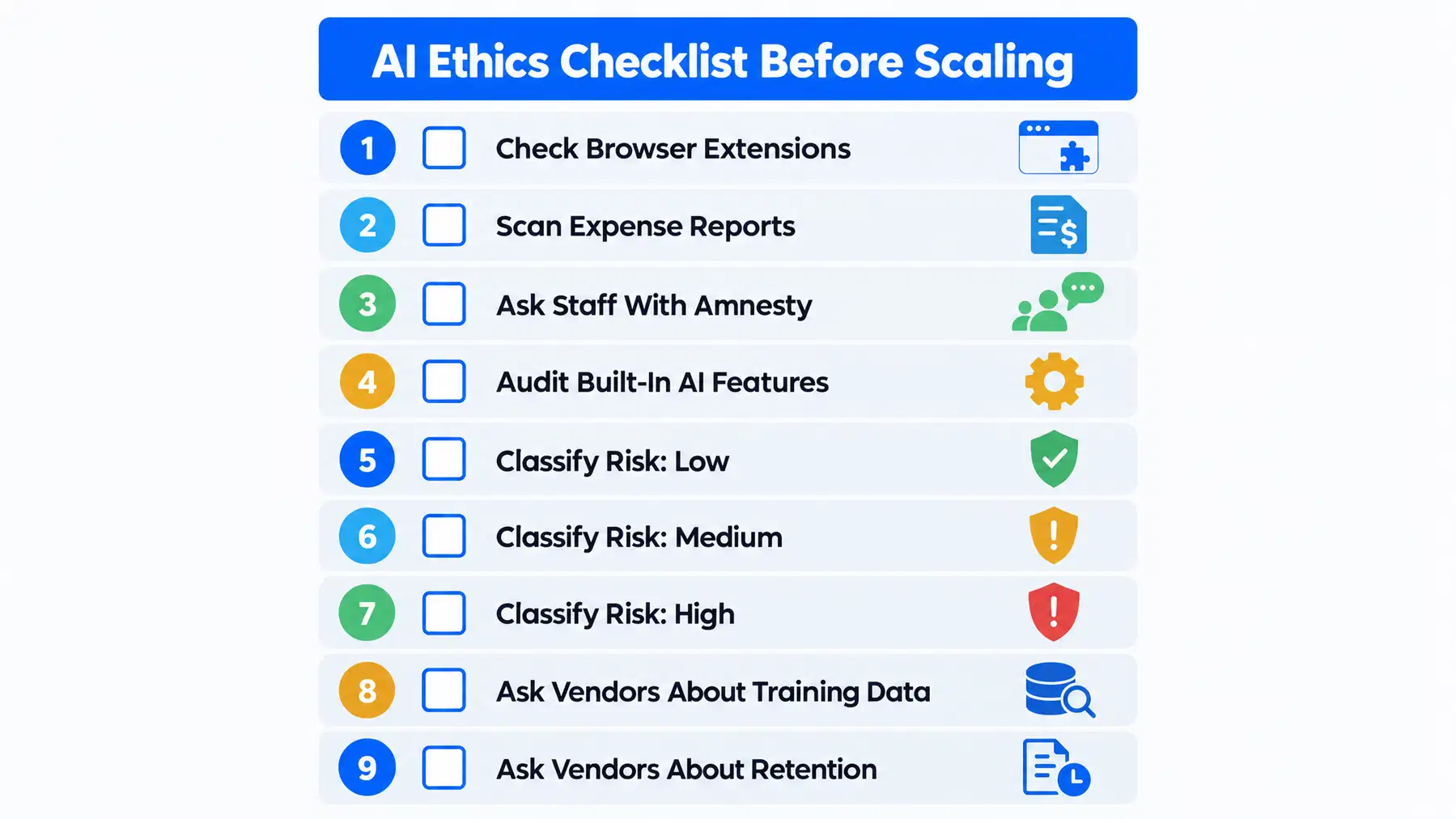
1. Inventory every AI tool already in use
You cannot govern what you have not found. Shadow AI, meaning tools adopted without approval, is almost always larger than owners expect.
- Check browser extensions and installed apps on company devices.
- Scan the last six months of expense reports and card statements for AI subscriptions.
- Ask staff directly, with an explicit amnesty, so people name tools instead of hiding them.
- Check which AI features are already switched on inside tools you pay for, such as your CRM or helpdesk.
It worked if: you have a single list with tool name, who uses it, what data goes in, and whether it is paid or free.
2. Assign one named owner for AI oversight
This is not a full-time compliance hire. It is one named person, usually the founder or the ops lead, who owns the list, approves new tools and is the escalation point when something goes wrong.
It worked if: every employee can name that person without looking it up.
3. Classify each use case by risk level
Sort every use case on your inventory into three tiers. This mirrors how the EU AI Act thinks, which sorts obligations by what the system is used for rather than how big the company is.
- Low: internal drafting, summarising, brainstorming, code comments.
- Medium: customer-facing content, support replies, marketing claims.
- High: anything influencing hiring, firing, credit, insurance, pricing or access to a service.
It worked if: each tool on your inventory has exactly one tier, and you can say in one sentence why.
4. Vet vendors on data handling before rollout
Ask these AI vendor due diligence questions in writing and keep the replies. A vendor that will not answer in writing has answered.
- Is our input data used to train your models, and can we opt out on our current plan?
- Where is the data stored and processed, and which sub-processors see it?
- How long is data retained, and can we delete it on request?
- What is your breach notification process and timeline to us?
- Do you have independent security certification, and can we see it?
It worked if: for every medium and high risk tool you hold a written answer to all five.
5. Write a one-page AI use policy
An AI ethics policy for a small business should fit on one page, because a ten-page version will not be read. Cover four things: approved tools, prohibited data types, disclosure rules and the escalation path.
Prohibited data types are the part people get wrong. Name them explicitly: customer personal data, health data, payment details, unreleased financials, anything under NDA.
It worked if: a new hire can read it in five minutes and correctly answer three sample questions about it.
6. Build in human review for consequential decisions
No fully automated output should decide hiring, firing, credit, pricing or service access. A named human reviews, can override, and signs off.
Make review real rather than ceremonial. The reviewer needs the inputs, the reasoning and enough time to disagree.
It worked if: you can show a record of at least one decision where a human changed the AI output.
7. Test outputs for bias and accuracy before and after launch
Low-budget bias testing is still testing. Build twenty sample inputs, then vary names, gender markers, locations and other demographic signals while holding qualifications identical, and compare the outputs.
This matters most in recruitment. US guidance notes that employers increasingly use algorithmic tools to screen qualifications, score resumes and run video interviews, and that these can lead to disability discrimination in hiring even where no discrimination is intended. Preventing AI bias in hiring starts with checking whether your screening tool penalises gaps, accents or non-standard histories.
It worked if: you have written results from a pre-launch test, plus weekly spot checks for the first month.
8. Train every employee who touches an AI tool
Thirty minutes removes most incident risk. Cover what not to paste in, how to spot a confidently wrong answer, when disclosure to a customer is required, and who to tell when something looks off.
It worked if: everyone with tool access has completed it and the date is recorded.
9. Log incidents and set a review cadence
A spreadsheet is enough: date, tool, what happened, data involved, who was affected, what you changed. Review the full checklist quarterly, or sooner if a scaling trigger fires.
It worked if: the log has entries. An empty log after three months usually means nobody is reporting, not that nothing happened.
What the EU AI Act and Other Regulations Actually Require of Small Businesses
The common fear is that EU AI Act small business compliance means heavy paperwork for anyone using a chatbot. For most small companies using general-purpose tools for drafting and summarising, obligations are lighter and centre on transparency, such as telling people when they are interacting with AI or seeing AI-generated content.
The important nuance is that obligations attach to the use case, not the headcount. A ten-person company using AI to screen job applicants can sit in a higher-scrutiny category, while a hundred-person company using AI only for internal notes may not. Size is not a shield.
In the US there is no single AI statute, but existing law already applies. Consumer protection enforcement by the Federal Trade Commission covers deceptive or unfair automated practices, and civil rights enforcement by the Department of Justice covers discriminatory outcomes from algorithmic tools. In both regions, an AI risk assessment for a small business is cheaper than an investigation.
Free Templates and Tools to Run This Checklist Yourself
You do not need to buy a governance platform to start. The NIST AI Risk Management Framework gives a free structure for mapping and measuring risk. Data protection authorities publish free impact assessment templates you can adapt for an AI tool. The EU's trustworthy AI assessment list works as a self-assessment companion, and academic work such as the AI-Y checklist for population ethics shows how checklist formats are being used to make ethical review repeatable rather than one-off.
Adapt one template, do not stack three. The goal is a document your team will actually open.
ZentrASI publishes practical resources on NextGen AI, machine learning and AI ethics for businesses that want to operate smarter and scale faster. If your scaling plan includes AI-driven content and search presence, our guide to earning visibility across Google and AI search platforms covers tools that automate content creation, match your brand voice and surface opportunities across communities and Q&A sites, which is the natural next step once your governance gates are in place.
When a Step Fails: What to Do Next
Failing a gate is the checklist working, not the checklist breaking. Handle it like this.
- Vendor will not answer data questions: restrict that tool to low-risk internal use only, or replace it.
- Bias test shows skewed outputs: stop the high-risk use immediately, revert to the human process, and only return with evidence the gap closed.
- Shadow tool found after rollout: add it to the inventory, run steps 3 and 4 on it, and check what data already went in.
- Nobody will own oversight: the founder owns it by default until someone else is named in writing.
- A real incident happens: contain it, log it, tell affected people if personal data was involved, then re-run the full checklist rather than patching one step.
A responsible AI checklist is only useful if it can tell you to stop. Keep the gates binary, keep the owner named, and re-run it on triggers rather than on good intentions.
Frequently asked questions
What should be in a basic AI ethics policy for a small company?
Four things, on one page: the list of approved tools, the data types that must never be entered into an AI tool, when you disclose AI use to customers, and who to escalate to when something goes wrong. Add the named oversight owner and the date of last review. Anything longer tends to go unread, which makes it worse than useless.
Does the EU AI Act apply to small businesses using free AI tools?
Obligations under the EU AI Act are tied to the risk of the use case rather than the size of the company or whether the tool is free. Most small businesses using general-purpose tools for drafting or summarising fall under lighter transparency duties. Using the same tool to screen job applicants or set credit terms moves you into a higher-scrutiny category.
How do I conduct an AI risk assessment without a dedicated compliance team?
Start with an inventory of every AI tool in use, then sort each use case into low, medium or high risk based on who is affected by the output. For medium and high cases, document the data involved, the vendor's answers on data handling, and the human review step. A founder can complete this in a day using a single spreadsheet.
What are the main ethical risks for small businesses using Generative AI?
The four that actually cause damage are data leakage into vendor systems, confidently wrong output published without checking, biased decisions about people, and undisclosed AI use that customers later discover. Each one maps to a step in the checklist above. The first two are the most common; the third is the most expensive.
How can small businesses prevent bias when using AI for hiring or credit?
Never let the system make the final call, and test it before you trust it by running identical qualifications with varied names, locations and demographic markers to see if outputs shift. US guidance warns that algorithmic hiring tools can produce disability discrimination even without intent, so screening for gaps or non-standard histories deserves particular attention. Keep records of the tests and of human overrides.
What questions should I ask AI vendors about data privacy and training?
Ask whether your inputs train their models and whether you can opt out on your current plan, where data is stored and which sub-processors access it, how long it is retained, and what their breach notification timeline to you is. Get the answers in writing. A vendor that avoids written answers has told you what you need to know.
Who should be responsible for AI oversight in a small team?
One named person, typically the founder or the operations lead, not a committee and not a future hire. Their job is to maintain the tool inventory, approve new tools, and act as the escalation point for incidents. The test is simple: if staff cannot name that person off the top of their head, the role does not exist.
Are there free templates for small business AI ethics checklists?
Yes. The NIST AI Risk Management Framework, data protection impact assessment templates published by data protection authorities, and the EU's Assessment List for Trustworthy AI are all free to use and adapt. Pick one and adapt it rather than combining several, so the result stays short enough to be used.
The ZentrASI team
Written by the people behind ZentrASI. ZentrASI is a digital publication and community dedicated to unlocking human potential through machine intelligence and Artificial Super Intelligence.